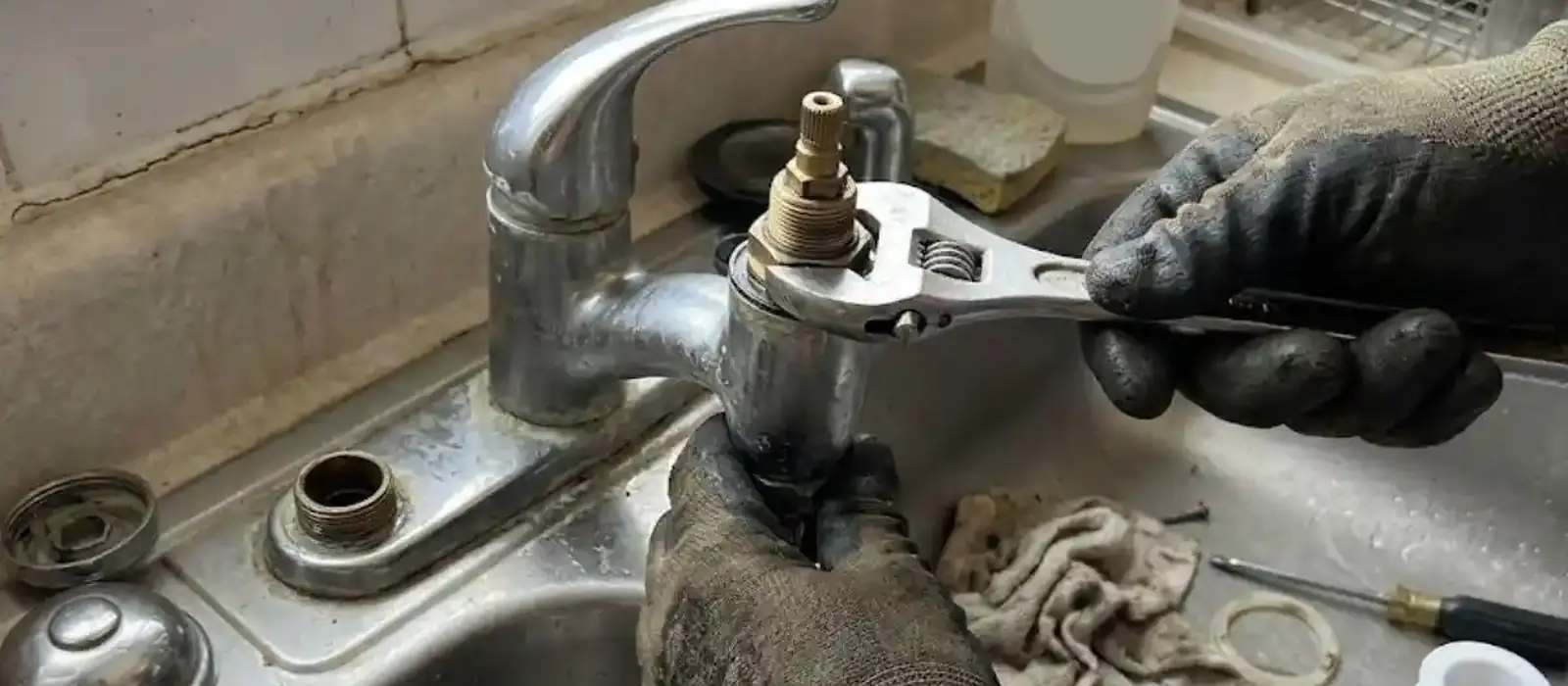
A dripping kitchen faucet wastes water and is annoying to live with. Most drips come from a worn cartridge, a damaged O-ring or a failed valve seat, and each of those is a small, inexpensive part. A careful homeowner can often fix it in less than an hour.
This guide shows how to tell where the leak is, what to do and when to hand it off.
Where is it leaking?
| Where the water shows. | Likely cause. | Part to replace. |
|---|---|---|
| Drips from the spout. | Worn cartridge or valve seat. | Cartridge, seats and springs. |
| Around the handle. | Failed O-ring or loose packing. | O-ring or packing nut. |
| At the base of the spout. | Worn spout O-rings. | Spout O-rings. |
| Under the sink. | Loose supply line or fitting. | Tighten or replace the line. |
A basic repair, step by step
Shut off the water.
Close the two valves under the sink. Open the faucet to drain it.
Plug the drain.
Put a cloth or stopper in the sink so small parts cannot fall in.
Take the faucet apart.
Remove the handle, cap and retaining nut. Take a photo at each step.
Replace the worn part.
Pull the cartridge or O-ring and bring it to the store to match it. Reassemble in reverse.
Match the part to the brand and model, which is often printed on the handle or the base. Using a cartridge that is almost the right one is a common reason repairs fail.
When it is time to replace the faucet
A corroded body.
A pitted or cracked faucet cannot be repaired.
Discontinued parts.
If the cartridge is no longer made, a new faucet is easier.
A finish that is peeling.
Plating wears off with age and with harsh cleaners.
Repeated leaks.
A faucet that leaks again within months may be worn throughout.
Kitchen faucet leaking?
Call to schedule a visit. Same-day appointments are possible when available.
Check under the sink too
While the cabinet is open, look at the supply lines and shutoffs for corrosion, drips and stains on the wood. A slow leak under a sink can rot the cabinet floor. If you find one, see faucet repair and consider leak detection if you suspect water reaches further.
Tools and parts to gather first
Before you start
- A flashlight, an adjustable wrench, an Allen key set and a screwdriver.
- Plumber's grease for new O-rings and cartridges.
- A towel and a small container for screws and caps.
- A phone to photograph each step.
- The brand and model of the faucet, written down.
Plumber's grease helps new O-rings seat and keeps them from drying out. A thin film is enough. Avoid petroleum jelly, which can swell rubber parts.
Ceramic disc and compression faucets
A ceramic disc cartridge, found in many newer single-handle faucets, rarely wears out, but mineral scale can stop it sealing. Soaking the cartridge in vinegar can clear it. Older compression faucets with two handles use rubber washers that wear and flatten, and replacing the washer and the seat usually fixes the drip.
Check the shutoffs while you are there
The two small valves under the sink are the ones you will want to work when something fails. Turn each one fully and back, to confirm that it moves and shuts off. A valve that is stuck or weeps at the stem is worth replacing when the faucet is apart, because a failed shutoff turns a simple repair into a trip to the main valve. A plumber can swap them in a few minutes.
Hard water and faucet wear in the New Iberia area
Water hardness in the New Iberia area depends on which system serves you. The Louisiana Water Company serves the City of New Iberia and Loreauville, and we do not guess its hardness here. Ask the company for its current water quality report.
For comparison, Iberia Water Works District 3 at Coteau reported treated water hardness of 65.4 mg/L in its 2025 report, and the City of Jeanerette reported 287.8 mg/L in 2024. Those numbers show how much water can differ within a short drive. Harder water scales aerators and wears cartridges faster.
Source types: Louisiana Department of Health consumer confidence reports for Iberia Water Works District 3 and the City of Jeanerette.
Where we work
We repair faucets in New Iberia and in nearby towns, including Jeanerette and St. Martinville.
Sources behind this page
According to the faucet maker's specification, cartridge sizes and part numbers vary by model, and the hardness figures come from consumer confidence reports filed with the Louisiana Department of Health.
Questions homeowners ask
The cartridge or valve seat is worn and no longer seals. Replacing it usually stops the drip.
Usually a screwdriver, an Allen key and an adjustable wrench. A cartridge puller helps for some brands.
Find the brand and model on the faucet. If it is not marked, take the old cartridge to a plumbing supply store to match it.
It depends on your water system. Ask the Louisiana Water Company or your provider for the current hardness figure, which appears in its water quality report.