Homeowners often ask for a number, such as every two years or every five. The honest answer is that no number fits every house. A newer home with plastic pipe and no big trees may never need routine cleaning. An older home with clay or cast iron pipe and a mature oak over the line may need it much more often.
This guide explains what decides the interval and how to set your own from what a camera shows.
What decides how often
Pipe material and age.
Clay and cast iron have rougher walls and more joints than modern plastic, so they catch debris and roots sooner.
Trees near the line.
Roots seek moisture and enter at joints. A big tree over the lateral raises the odds of a stoppage.
Household habits.
Grease, wipes and heavy use of a disposal speed buildup.
History of backups.
Two backups in a few years say the line needs attention before the third.
A practical approach
Get a baseline.
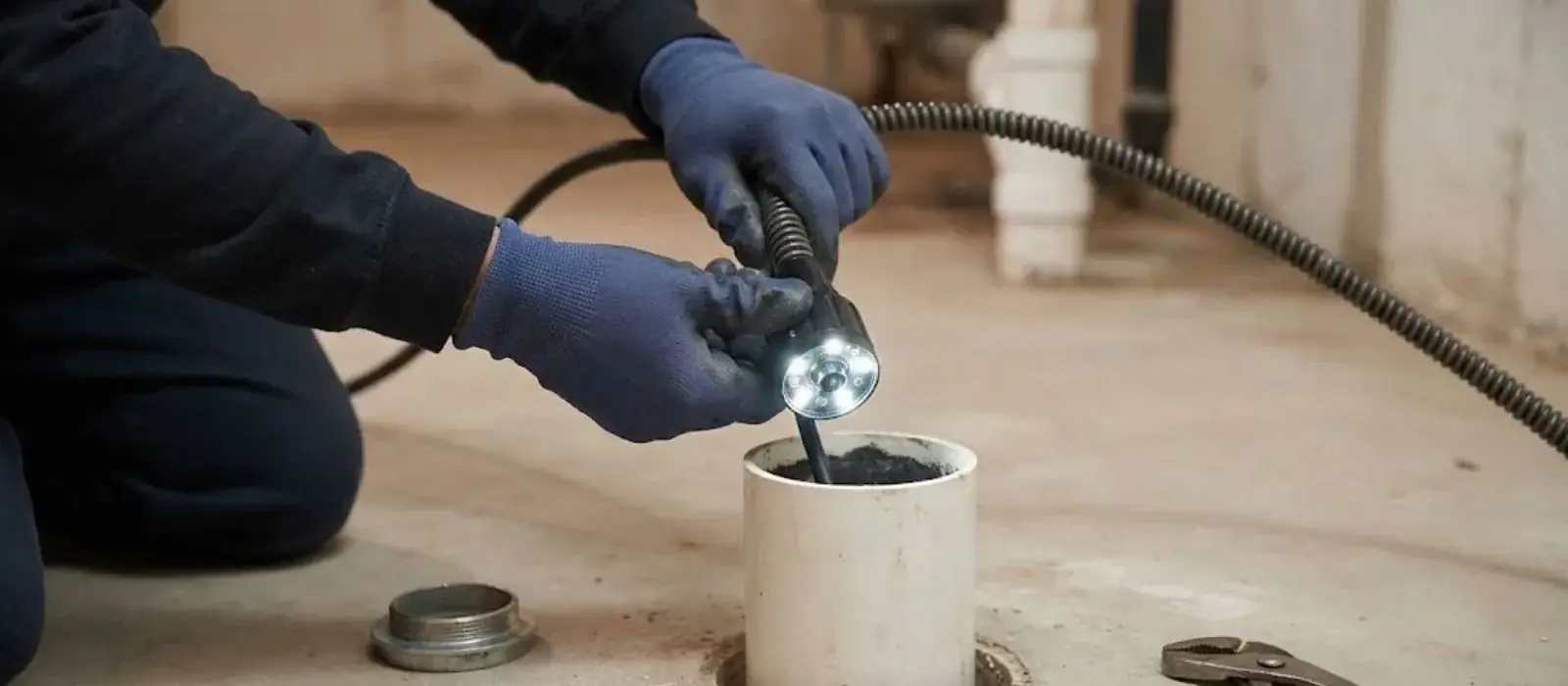
A camera inspection shows what the pipe is, what shape it is in and how much buildup there is.
Clean if the camera shows buildup.
Cable or jet the line to a clean wall.
Re-inspect.
A second camera pass after a year or two shows how fast things return.
Set your interval.
If the line is clean after two years, wait longer. If roots grew back, shorten it.
That approach uses your own pipe as the guide. A sewer inspection is the starting point, and sewer line cleaning is the follow-up.
Warning signs that cleaning is overdue
Act sooner if you notice
- Slow drains in more than one fixture.
- Gurgling after a flush or when the washer drains.
- A sewer smell from a floor drain or the yard.
- A tub or low drain that backs up when the washer runs.
- Wet spots or lush green patches over the line in the yard.
Slow drains throughout the house?
Call and describe the pattern. The plumber can tell you what it likely means.
Cable or jet
A cable cuts roots and opens a blockage. A jet scours the whole wall and removes grease and scale. Many plumbers use a cable first and a jet when the camera shows a coated wall. See hydro jetting for the details.
What trees and roots do
Tree roots look for water and nutrients, and a sewer line leaks tiny amounts at joints that are just enough to attract them. A hair-thin root enters, then thickens into a mat that catches paper and grease. A camera shows the roots clearly, and a cutting head on a cable can clear them. Without repairing the joint, though, the roots tend to return.
If the camera shows roots entering at the same joint every time, the better long-term answer may be a spot repair or a liner, which seals the opening. See sewer line repair for those options.
A schedule you can actually follow
Write down the date of each cleaning and what the camera showed. That log turns guesswork into a plan. A clean line at the first look may need a camera visit only every few years. A line with grease or roots may justify a yearly visit until you learn how fast it returns.
When a cleaning is not enough
Sometimes cleaning shows a problem that cleaning cannot solve. A sag, called a belly, holds water and waste, and no amount of cabling will level it. A cracked or offset joint lets roots and soil in. If the camera shows either, ask for the repair options and prices, so you can compare the cost of repeated cleanings with a permanent fix. The answer is often a spot repair at the one bad joint.
New Iberia's sewer system and your private line
The City of New Iberia Wastewater Department runs about 120 miles of sewer line, 2,200 manholes and 75 pump stations. That is the public system. Your lateral, the line from the house to the public main, is yours to maintain.
If a cleaning shows the blockage is in the public main, the department's emergency numbers are (337) 369-2347 on weekdays and (337) 373-3111 after 4:30 pm, on weekends and on holidays. Outside the city, its page lists Iberia Parish Sewerage District No. 1 at (337) 369-2376.
Source type: City of New Iberia Wastewater Department web page.
Where we work
We clean and inspect sewer lines in New Iberia and in nearby towns, including Delcambre and Loreauville. Same-day appointments are possible when a slot is open.
Sources behind this page
Cleaning intervals here come from what camera footage shows, not a fixed standard. The City of New Iberia Wastewater Department, according to its website, maintains the public main only.
Questions homeowners ask
Not as a rule. If a camera shows a clean pipe, annual cleaning is unnecessary. A line with roots or grease may need it more often.
It is for older homes and those with trees. A camera look every few years is a cheap way to catch trouble early.
Careful cabling and the right jet pressure are safe on sound pipe. On cracked or collapsed pipe, they can make damage worse, which is why a camera comes first.
You do, from the house to the public main. In New Iberia, the Wastewater Department maintains the public main and its pump stations.